
HiddenLayer in the News
See how our research, leadership, and innovations are shaping the global conversation on AI security.

min read
HiddenLayer “Awardable” for Department of Defense Work in the CDAO’s Tradewinds Solutions Marketplace
AUSTIN, TX – June 2, 2026 – HiddenLayer, a leading provider of AI security solutions for enterprises and government organizations, today announced that it has achieved Awardable status through the Chief Digital and Artificial Intelligence Office’s (CDAO) Tradewinds Solutions Marketplace.
The Tradewinds Solutions Marketplace is the premier offering of Tradewinds, the Department of Defense’s (DoD’s) suite of tools and services designed to accelerate the procurement and adoption of Artificial Intelligence (AI), Machine Learning (ML), data, and analytics capabilities.
HiddenLayer’s platform is designed to secure AI systems and AI Agents throughout the entire AI lifecycle by providing detection, monitoring, and protection against emerging AI threats and vulnerabilities. HiddenLayer supports organizations across the public and private sectors in safely deploying and operationalizing AI technologies.
“We are honored to receive Awardable status through the Tradewinds Solutions Marketplace,” said Christopher Sestito, CEO and Co-Founder at HiddenLayer. “As AI adoption accelerates across the federal government and national security community, securing AI systems and AI Agents is mission-critical. This designation reinforces our commitment to helping government organizations confidently adopt AI technologies while protecting them from evolving threats.”
HiddenLayer’s video describing the AI Security Platform is accessible to government customers through the Tradewinds Solutions Marketplace and demonstrates how organizations can strengthen the security and resilience of AI and machine learning systems against adversarial attacks, model compromise, and emerging AI-specific cyber risks.
HiddenLayer was recognized among a competitive field of applicants whose solutions demonstrated innovation, scalability, and potential impact on national security missions. Government customers interested in viewing the video solution can create a Tradewinds Solutions Marketplace account at www.tradewindai.com.
About HiddenLayer
HiddenLayer protects predictive, generative, and agentic AI applications across the entire AI lifecycle, from discovery and AI supply chain security to attack simulation and runtime protection. Backed by patented technology and industry-leading adversarial AI research, our platform is purpose-built to defend AI systems against evolving threats. HiddenLayer protects intellectual property, helps ensure regulatory compliance, and enables organizations to safely adopt and scale AI with confidence.
About the Tradewinds Solutions Marketplace
The Tradewinds Solutions Marketplace is a digital repository of post-competition, readily awardable pitch videos that address the Department of Defense’s most significant challenges in the Artificial Intelligence/Machine Learning (AI/ML), data, and analytics space. All awardable solutions have been assessed through complex scoring rubrics and competitive procedures and are available to government customers with a Marketplace account. Tradewinds is housed within the DoD’s Chief Digital and Artificial Intelligence Office (CDAO).
Media Contact
SutherlandGold for HiddenLayer
hiddenlayer@sutherlandgold.com
min read
HiddenLayer “Awardable” for Department of Defense Work in the CDAO’s Tradewinds Solutions Marketplace
AUSTIN, TX – June 2, 2026 – HiddenLayer, a leading provider of AI security solutions for enterprises and government organizations, today announced that it has achieved Awardable status through the Chief Digital and Artificial Intelligence Office’s (CDAO) Tradewinds Solutions Marketplace.
The Tradewinds Solutions Marketplace is the premier offering of Tradewinds, the Department of Defense’s (DoD’s) suite of tools and services designed to accelerate the procurement and adoption of Artificial Intelligence (AI), Machine Learning (ML), data, and analytics capabilities.
HiddenLayer’s platform is designed to secure AI systems and AI Agents throughout the entire AI lifecycle by providing detection, monitoring, and protection against emerging AI threats and vulnerabilities. HiddenLayer supports organizations across the public and private sectors in safely deploying and operationalizing AI technologies.
“We are honored to receive Awardable status through the Tradewinds Solutions Marketplace,” said Christopher Sestito, CEO and Co-Founder at HiddenLayer. “As AI adoption accelerates across the federal government and national security community, securing AI systems and AI Agents is mission-critical. This designation reinforces our commitment to helping government organizations confidently adopt AI technologies while protecting them from evolving threats.”
HiddenLayer’s video describing the AI Security Platform is accessible to government customers through the Tradewinds Solutions Marketplace and demonstrates how organizations can strengthen the security and resilience of AI and machine learning systems against adversarial attacks, model compromise, and emerging AI-specific cyber risks.
HiddenLayer was recognized among a competitive field of applicants whose solutions demonstrated innovation, scalability, and potential impact on national security missions. Government customers interested in viewing the video solution can create a Tradewinds Solutions Marketplace account at www.tradewindai.com.
About HiddenLayer
HiddenLayer protects predictive, generative, and agentic AI applications across the entire AI lifecycle, from discovery and AI supply chain security to attack simulation and runtime protection. Backed by patented technology and industry-leading adversarial AI research, our platform is purpose-built to defend AI systems against evolving threats. HiddenLayer protects intellectual property, helps ensure regulatory compliance, and enables organizations to safely adopt and scale AI with confidence.
About the Tradewinds Solutions Marketplace
The Tradewinds Solutions Marketplace is a digital repository of post-competition, readily awardable pitch videos that address the Department of Defense’s most significant challenges in the Artificial Intelligence/Machine Learning (AI/ML), data, and analytics space. All awardable solutions have been assessed through complex scoring rubrics and competitive procedures and are available to government customers with a Marketplace account. Tradewinds is housed within the DoD’s Chief Digital and Artificial Intelligence Office (CDAO).
Media Contact
SutherlandGold for HiddenLayer
hiddenlayer@sutherlandgold.com
%20(1).webp)
min read
HiddenLayer Unveils New Agentic Runtime Security Capabilities for Securing Autonomous AI Execution
Austin, TX – March 23, 2026 – HiddenLayer, the leading AI security company, today announced the next generation of its AI Runtime Security module, introducing new capabilities designed to protect autonomous AI agents as they make decisions and take action. As enterprises increasingly adopt agentic AI systems, these capabilities extend HiddenLayer’s AI Runtime Security platform to secure what matters most in agentic AI: how agents behave and take actions.
The update introduces three core capabilities for securing agentic AI workloads:
• Agentic Runtime Visibility
• Agentic Investigation & Threat Hunting
• Agentic Detection & Enforcement
One in eight AI breaches are linked to agentic systems, according to HiddenLayer’s 2026 AI Threat Landscape Report. Each agent interaction expands the operational blast radius and introduces new forms of runtime risk. Yet most AI security controls stop at prompts, policies, or static permissions, and execution-time behavior remains largely unobserved and uncontrolled.
These new agentic security capabilities give security teams visibility into how agents execute. They enable them to detect and stop risks in multi-step autonomous workflows, including prompt injection, malicious tool calls, and data exfiltration before sensitive information is exposed.
“AI agents operate at machine speed. If they’re compromised, they can access systems, move data, and take action in seconds — far faster than any human could intervene,” said Chris Sestito, CEO of HiddenLayer. “That velocity changes the security equation entirely. Agentic Runtime Security gives enterprises the real-time visibility and control they need to stop damage before it spreads.”
With these new capabilities, security teams can:
- Gain complete runtime visibility into AI agent behavior — Reconstruct every session to see how agents interact with data, tools, and other agents, providing full operational context behind every action and decision.
- Investigate and hunt across agentic activity — Search, filter, and pivot across sessions, tools, and execution paths to identify anomalous behavior and uncover evolving threats. Validated findings can be easily operationalized into enforceable runtime policies, reducing friction between investigation and response.
- Detect and prevent multi-step agentic threats — Identify prompt injections, malicious tool calls, data exfiltration, and cascading attack chains unique to autonomous agents, ensuring real-time protection from evolving risks.
- Enforce adaptive security policies in real time — Automatically control agent access, redact sensitive data, and block unsafe or unauthorized actions based on context, keeping operations compliant and contained.
“As we expand the use of AI agents across our business, maintaining control and oversight is critical,” said Charles Iheagwara, AI/ML Security Leader at AstraZeneca. "Our goal is to have full scope visibility across all platforms and silos, so we’re focused on putting capabilities in place to monitor agent execution and ensure they operate safely and reliably at scale.”
Agentic Runtime Security supports enterprises as they expand agentic AI adoption, integrating directly into agent gateways and execution frameworks to enable phased deployment without application rewrites.
“Agentic AI changes the risk model because decisions and actions are happening continuously at runtime,” said Caroline Wong, Chief Strategy Officer at Axari. “HiddenLayer’s new capabilities give us the visibility into agent behavior that’s been missing, so we can safely move these systems into production with more confidence.”
The new agentic capabilities for HiddenLayer’s AI Runtime Security are available now as part of HiddenLayer’s AI Security Platform, enabling organizations to gain immediate agentic runtime visibility and detection and expand to full threat-hunting and enforcement as their AI agent programs mature.
Find more information at hiddenlayer.com/agents and contact sales@hiddenlayer.com to schedule a demo.

min read
HiddenLayer Releases the 2026 AI Threat Landscape Report, Spotlighting the Rise of Agentic AI and the Expanding Attack Surface of Autonomous Systems
HiddenLayer secures agentic, generative, and predictAutonomous agents now account for more than 1 in 8 reported AI breaches as enterprises move from experimentation to production.
March 18, 2026 – Austin, TX – HiddenLayer, the leading AI security company protecting enterprises from adversarial machine learning and emerging AI-driven threats, today released its 2026 AI Threat Landscape Report, a comprehensive analysis of the most pressing risks facing organizations as AI systems evolve from assistive tools to autonomous agents capable of independent action.
Based on a survey of 250 IT and security leaders, the report reveals a growing tension at the heart of enterprise AI adoption: organizations are embedding AI deeper into critical operations while simultaneously expanding their exposure to entirely new attack surfaces.
While agentic AI remains in the early stages of enterprise deployment, the risks are already materializing. One in eight reported AI breaches is now linked to agentic systems, signaling that security frameworks and governance controls are struggling to keep pace with AI’s rapid evolution. As these systems gain the ability to browse the web, execute code, access tools, and carry out multi-step workflows, their autonomy introduces new vectors for exploitation and real-world system compromise.
“Agentic AI has evolved faster in the past 12 months than most enterprise security programs have in the past five years,” said Chris Sestito, CEO and Co-founder of HiddenLayer. “It’s also what makes them risky. The more authority you give these systems, the more reach they have, and the more damage they can cause if compromised. Security has to evolve without limiting the very autonomy that makes these systems valuable.”
Other findings in the report include:
AI Supply Chain Exposure Is Widening
- Malware hidden in public model and code repositories emerged as the most cited source of AI-related breaches (35%).
- Yet 93% of respondents continue to rely on open repositories for innovation, revealing a trade-off between speed and security.
Visibility and Transparency Gaps Persist
- Over a third (31%) of organizations do not know whether they experienced an AI security breach in the past 12 months.
- Although 85% support mandatory breach disclosure, more than half (53%) admit they have withheld breach reporting due to fear of backlash, underscoring a widening hypocrisy between transparency advocacy and real-world behavior.
Shadow AI Is Accelerating Across Enterprises
- Over 3 in 4 (76%) of organizations now cite shadow AI as a definite or probable problem, up from 61% in 2025, a 15-point year-over-year increase and one of the largest shifts in the dataset.
- Yet only one-third (34%) of organizations partner externally for AI threat detection, indicating that awareness is accelerating faster than governance and detection mechanisms.
Ownership and Investment Remain Misaligned
- While many organizations recognize AI security risks, internal responsibility remains unclear with 73% reporting internal conflict over ownership of AI security controls.
- Additionally, while 91% of organizations added AI security budgets for 2025, more than 40% allocated less than 10% of their budget on AI security.
“One of the clearest signals in this year’s research is how fast AI has evolved from simple chat interfaces to fully agentic systems capable of autonomous action,” said Marta Janus, Principal Security Researcher at HiddenLayer. “As soon as agents can browse the web, execute code, and trigger real-world workflows, prompt injection is no longer just a model flaw. It becomes an operational security risk with direct paths to system compromise. The rise of agentic AI fundamentally changes the threat model, and most enterprise controls were not designed for software that can think, decide, and act on its own.”
What’s New in AI: Key Trends Shaping the 2026 Threat Landscape
Over the past year, three major shifts have expanded both the power, and the risk, of enterprise AI deployments:
- Agentic AI systems moved rapidly from experimentation to production in 2025. These agents can browse the web, execute code, access files, and interact with other agents—transforming prompt injection, supply chain attacks, and misconfigurations into pathways for real-world system compromise.
- Reasoning and self-improving models have become mainstream, enabling AI systems to autonomously plan, reflect, and make complex decisions. While this improves accuracy and utility, it also increases the potential blast radius of compromise, as a single manipulated model can influence downstream systems at scale.
- Smaller, highly specialized “edge” AI models are increasingly deployed on devices, vehicles, and critical infrastructure, shifting AI execution away from centralized cloud controls. This decentralization introduces new security blind spots, particularly in regulated and safety-critical environments.
The report finds that security controls, authentication, and monitoring have not kept pace with this growth, leaving many organizations exposed by default.
HiddenLayer’s AI Security Platform secures AI systems across the full AI lifecycle with four integrated modules: AI Discovery, which identifies and inventories AI assets across environments to give security teams complete visibility into their AI footprint; AI Supply Chain Security, which evaluates the security and integrity of models and AI artifacts before deployment; AI Attack Simulation, which continuously tests AI systems for vulnerabilities and unsafe behaviors using adversarial techniques; and AI Runtime Security, which monitors models in production to detect and stop attacks in real time.
Access the full report here.
About HiddenLayer
ive AI applications across the entire AI lifecycle, from discovery and AI supply chain security to attack simulation and runtime protection. Backed by patented technology and industry-leading adversarial AI research, our platform is purpose-built to defend AI systems against evolving threats. HiddenLayer protects intellectual property, helps ensure regulatory compliance, and enables organizations to safely adopt and scale AI with confidence.
Contact
SutherlandGold for HiddenLayer
hiddenlayer@sutherlandgold.com
min read
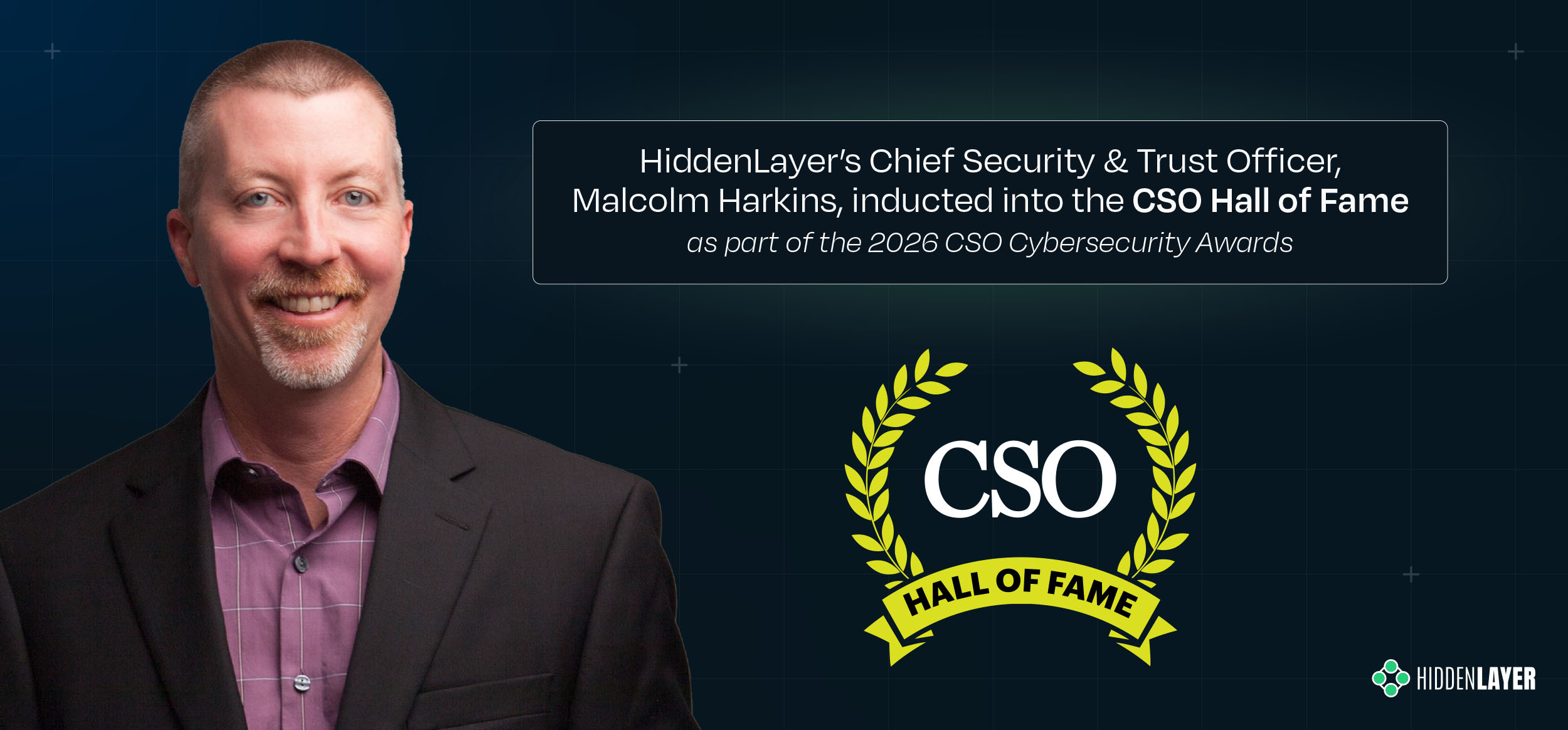
HiddenLayer’s Malcolm Harkins Inducted into the CSO Hall of Fame
Austin, TX — March 10, 2026 — HiddenLayer, the leading AI security company protecting enterprises from adversarial machine learning and emerging AI-driven threats, today announced that Malcolm Harkins, Chief Security & Trust Officer, has been inducted into the CSO Hall of Fame, recognizing his decades-long contributions to advancing cybersecurity and information risk management.
The CSO Hall of Fame honors influential leaders who have demonstrated exceptional impact in strengthening security practices, building resilient organizations, and advancing the broader cybersecurity profession. Harkins joins an accomplished group of security executives recognized for shaping how organizations manage risk and defend against emerging threats.
Throughout his career, Harkins has helped organizations navigate complex security challenges while aligning cybersecurity with business strategy. His work has focused on strengthening governance, improving risk management practices, and helping enterprises responsibly adopt emerging technologies, including artificial intelligence.
At HiddenLayer, Harkins plays a key role in guiding the company’s security and trust initiatives as organizations increasingly deploy AI across critical business functions. His leadership helps ensure that enterprises can adopt AI securely while maintaining resilience, compliance, and operational integrity.
“Malcolm’s career has consistently demonstrated what it means to lead in cybersecurity,” said Chris Sestito, CEO and Co-founder of HiddenLayer. “His commitment to advancing security risk management and helping organizations navigate emerging technologies has had a lasting impact across the industry. We’re incredibly proud to see him recognized by the CSO Hall of Fame.”
The 2026 CSO Hall of Fame inductees will be formally recognized at the CSO Cybersecurity Awards & Conference, taking place May 11–13, 2026, in Nashville, Tennessee.
The CSO Hall of Fame, presented by CSO, recognizes security leaders whose careers have significantly advanced the practice of information risk management and security. Inductees are selected for their leadership, innovation, and lasting contributions to the cybersecurity community.
About HiddenLayer
HiddenLayer secures agentic, generative, and predictive AI applications across the entire AI lifecycle, from discovery and AI supply chain security to attack simulation and runtime protection. Backed by patented technology and industry-leading adversarial AI research, our platform is purpose-built to defend AI systems against evolving threats. HiddenLayer protects intellectual property, helps ensure regulatory compliance, and enables organizations to safely adopt and scale AI with confidence.
Contact
SutherlandGold for HiddenLayer
hiddenlayer@sutherlandgold.com
min read
HiddenLayer Selected as Awardee on $151B Missile Defense Agency SHIELD IDIQ Supporting the Golden Dome Initiative
Underpinning HiddenLayer’s unique solution for the DoD and USIC is HiddenLayer’s Airgapped AI Security Platform, the first solution designed to protect AI models and development processes in fully classified, disconnected environments. Deployed locally within customer-controlled environments, the platform supports strict US Federal security requirements while delivering enterprise-ready detection, scanning, and response capabilities essential for national security missions.
Austin, TX – December 23, 2025 – HiddenLayer, the leading provider of Security for AI, today announced it has been selected as an awardee on the Missile Defense Agency’s (MDA) Scalable Homeland Innovative Enterprise Layered Defense (SHIELD) multiple-award, indefinite-delivery/indefinite-quantity (IDIQ) contract. The SHIELD IDIQ has a ceiling value of $151 billion and serves as a core acquisition vehicle supporting the Department of Defense’s Golden Dome initiative to rapidly deliver innovative capabilities to the warfighter.
The program enables MDA and its mission partners to accelerate the deployment of advanced technologies with increased speed, flexibility, and agility. HiddenLayer was selected based on its successful past performance with ongoing US Federal contracts and projects with the Department of Defence (DoD) and United States Intelligence Community (USIC). “This award reflects the Department of Defense’s recognition that securing AI systems, particularly in highly-classified environments is now mission-critical,” said Chris “Tito” Sestito, CEO and Co-founder of HiddenLayer. “As AI becomes increasingly central to missile defense, command and control, and decision-support systems, securing these capabilities is essential. HiddenLayer’s technology enables defense organizations to deploy and operate AI with confidence in the most sensitive operational environments.”
Underpinning HiddenLayer’s unique solution for the DoD and USIC is HiddenLayer’s Airgapped AI Security Platform, the first solution designed to protect AI models and development processes in fully classified, disconnected environments. Deployed locally within customer-controlled environments, the platform supports strict US Federal security requirements while delivering enterprise-ready detection, scanning, and response capabilities essential for national security missions.
HiddenLayer’s Airgapped AI Security Platform delivers comprehensive protection across the AI lifecycle, including:
- Comprehensive Security for Agentic, Generative, and Predictive AI Applications: Advanced AI discovery, supply chain security, testing, and runtime defense.
- Complete Data Isolation: Sensitive data remains within the customer environment and cannot be accessed by HiddenLayer or third parties unless explicitly shared.
- Compliance Readiness: Designed to support stringent federal security and classification requirements.
- Reduced Attack Surface: Minimizes exposure to external threats by limiting unnecessary external dependencies.
“By operating in fully disconnected environments, the Airgapped AI Security Platform provides the peace of mind that comes with complete control,” continued Sestito. “This release is a milestone for advancing AI security where it matters most: government, defense, and other mission-critical use cases.”
The SHIELD IDIQ supports a broad range of mission areas and allows MDA to rapidly issue task orders to qualified industry partners, accelerating innovation in support of the Golden Dome initiative’s layered missile defense architecture.
Performance under the contract will occur at locations designated by the Missile Defense Agency and its mission partners.
About HiddenLayer
HiddenLayer, a Gartner-recognized Cool Vendor for AI Security, is the leading provider of Security for AI. Its security platform helps enterprises safeguard their agentic, generative, and predictive AI applications. HiddenLayer is the only company to offer turnkey security for AI that does not add unnecessary complexity to models and does not require access to raw data and algorithms. Backed by patented technology and industry-leading adversarial AI research, HiddenLayer’s platform delivers supply chain security, runtime defense, security posture management, and automated red teaming.
Contact
SutherlandGold for HiddenLayer
hiddenlayer@sutherlandgold.com
min read
HiddenLayer Announces AWS GenAI Integrations, AI Attack Simulation Launch, and Platform Enhancements to Secure Bedrock and AgentCore Deployments
As organizations rapidly adopt generative AI, they face increasing risks of prompt injection, data leakage, and model misuse. HiddenLayer’s security technology, built on AWS, helps enterprises address these risks while maintaining speed and innovation.
AUSTIN, TX — December 1, 2025 — HiddenLayer, the leading AI security platform for agentic, generative, and predictive AI applications, today announced expanded integrations with Amazon Web Services (AWS) Generative AI offerings and a major platform update debuting at AWS re:Invent 2025. HiddenLayer offers additional security features for enterprises using generative AI on AWS, complementing existing protections for models, applications, and agents running on Amazon Bedrock, Amazon Bedrock AgentCore, Amazon SageMaker, and SageMaker Model Serving Endpoints.
As organizations rapidly adopt generative AI, they face increasing risks of prompt injection, data leakage, and model misuse. HiddenLayer’s security technology, built on AWS, helps enterprises address these risks while maintaining speed and innovation.
“As organizations embrace generative AI to power innovation, they also inherit a new class of risks unique to these systems,” said Chris Sestito, CEO and Co-Founder of HiddenLayer. “Working with AWS, we’re ensuring customers can innovate safely, bringing trust, transparency, and resilience to every layer of their AI stack.”
Built on AWS to Accelerate Secure AI Innovation
HiddenLayer’s AI Security Platform and integrations are available in AWS Marketplace, offering native support for Amazon Bedrock and Amazon SageMaker. The company complements AWS infrastructure security by providing AI-specific threat detection, identifying risks within model inference and agent cognition that traditional tools overlook.
Through automated security gates, continuous compliance validation, and real-time threat blocking, HiddenLayer enables developers to maintain velocity while giving security teams confidence and auditable governance for AI deployments.
Alongside these integrations, HiddenLayer is introducing a complete platform redesign and the launches of a new AI Discovery module and an enhanced AI Attack Simulation module, further strengthening its end-to-end AI Security Platform that protects agentic, generative, and predictive AI systems.
Key enhancements include:
- AI Discovery: Identifies AI assets within technical environments to build AI asset inventories
- AI Attack Simulation: Automates adversarial testing and Red Teaming to identify vulnerabilities before deployment.
- Complete UI/UX Revamp: Simplified sidebar navigation and reorganized settings for faster workflows across AI Discovery, AI Supply Chain Security, AI Attack Simulation, and AI Runtime Security.
- Enhanced Analytics: Filterable and exportable data tables, with new module-level graphs and charts.
- Security Dashboard Overview: Unified view of AI posture, detections, and compliance trends.
- Learning Center: In-platform documentation and tutorials, with future guided walkthroughs.
HiddenLayer will demonstrate these capabilities live at AWS re:Invent 2025, December 1–5 in Las Vegas.
To learn more or request a demo, visit https://hiddenlayer.com/reinvent2025/.
About HiddenLayer
HiddenLayer, a Gartner-recognized Cool Vendor for AI Security, is the leading provider of Security for AI. Its platform helps enterprises safeguard agentic, generative, and predictive AI applications without adding unnecessary complexity or requiring access to raw data and algorithms. Backed by patented technology and industry-leading adversarial AI research, HiddenLayer delivers supply chain security, runtime defense, posture management, and automated red teaming.
For more information, visit www.hiddenlayer.com.
Press Contact:
SutherlandGold for HiddenLayer
hiddenlayer@sutherlandgold.com
min read
HiddenLayer Joins Databricks’ Data Intelligence Platform for Cybersecurity
On September 30, Databricks officially launched its <a href="https://www.databricks.com/blog/transforming-cybersecurity-data-intelligence?utm_source=linkedin&utm_medium=organic-social">Data Intelligence Platform for Cybersecurity</a>, marking a significant step in unifying data, AI, and security under one roof. At HiddenLayer, we’re proud to be part of this new data intelligence platform, as it represents a significant milestone in the industry's direction.
On September 30, Databricks officially launched its Data Intelligence Platform for Cybersecurity, marking a significant step in unifying data, AI, and security under one roof. At HiddenLayer, we’re proud to be part of this new data intelligence platform, as it represents a significant milestone in the industry's direction.
Why Databricks’ Data Intelligence Platform for Cybersecurity Matters for AI Security
Cybersecurity and AI are now inseparable. Modern defenses rely heavily on machine learning models, but that also introduces new attack surfaces. Models can be compromised through adversarial inputs, data poisoning, or theft. These attacks can result in missed fraud detection, compliance failures, and disrupted operations.
Until now, data platforms and security tools have operated mainly in silos, creating complexity and risk.
The Databricks Data Intelligence Platform for Cybersecurity is a unified, AI-powered, and ecosystem-driven platform that empowers partners and customers to modernize security operations, accelerate innovation, and unlock new value at scale.
How HiddenLayer Secures AI Applications Inside Databricks
HiddenLayer adds the critical layer of security for AI models themselves. Our technology scans and monitors machine learning models for vulnerabilities, detects adversarial manipulation, and ensures models remain trustworthy throughout their lifecycle.
By integrating with Databricks Unity Catalog, we make AI application security seamless, auditable, and compliant with emerging governance requirements. This empowers organizations to demonstrate due diligence while accelerating the safe adoption of AI.
The Future of Secure AI Adoption with Databricks and HiddenLayer
The Databricks Data Intelligence Platform for Cybersecurity marks a turning point in how organizations must approach the intersection of AI, data, and defense. HiddenLayer ensures the AI applications at the heart of these systems remain safe, auditable, and resilient against attack.
As adversaries grow more sophisticated and regulators demand greater transparency, securing AI is an immediate necessity. By embedding HiddenLayer directly into the Databricks ecosystem, enterprises gain the assurance that they can innovate with AI while maintaining trust, compliance, and control.
In short, the future of cybersecurity will not be built solely on data or AI, but on the secure integration of both. Together, Databricks and HiddenLayer are making that future possible.
FAQ: Databricks and HiddenLayer AI Security
What is the Databricks Data Intelligence Platform for Cybersecurity?
The Databricks Data Intelligence Platform for Cybersecurity delivers the only unified, AI-powered, and ecosystem-driven platform that empowers partners and customers to modernize security operations, accelerate innovation, and unlock new value at scale.
Why is AI application security important?
AI applications and their underlying models can be attacked through adversarial inputs, data poisoning, or theft. Securing models reduces risks of fraud, compliance violations, and operational disruption.
How does HiddenLayer integrate with Databricks?
HiddenLayer integrates with Databricks Unity Catalog to scan models for vulnerabilities, monitor for adversarial manipulation, and ensure compliance with AI governance requirements.

min read
HiddenLayer Appoints Chelsea Strong as Chief Revenue Officer to Accelerate Global Growth and Customer Expansion
As CRO, Strong will lead HiddenLayer’s global sales strategy, customer success, and go-to-market execution as the company continues to meet surging demand for AI/ML security solutions across industries. Her appointment signals HiddenLayer’s continued commitment to building a world-class executive team with deep experience in navigating rapid expansion while staying focused on customer success.
AUSTIN, TX — July 16, 2025 — HiddenLayer, the leading provider of security solutions for artificial intelligence, is proud to announce the appointment of Chelsea Strong as Chief Revenue Officer (CRO). With over 25 years of experience driving enterprise sales and business development across the cybersecurity and technology landscape, Strong brings a proven track record of scaling revenue operations in high-growth environments.
As CRO, Strong will lead HiddenLayer’s global sales strategy, customer success, and go-to-market execution as the company continues to meet surging demand for AI/ML security solutions across industries. Her appointment signals HiddenLayer’s continued commitment to building a world-class executive team with deep experience in navigating rapid expansion while staying focused on customer success.
“Chelsea brings a rare combination of startup precision and enterprise scale,” said Chris Sestito, CEO and Co-Founder of HiddenLayer. “She’s not only built and led high-performing teams at some of the industry’s most innovative companies, but she also knows how to establish the infrastructure for long-term growth. We’re thrilled to welcome her to the leadership team as we continue to lead in AI security.”
Before joining HiddenLayer, Strong held senior leadership positions at cybersecurity innovators, including HUMAN Security, Blue Lava, and Obsidian Security, where she specialized in building teams, cultivating customer relationships, and shaping emerging markets. She also played pivotal early sales roles at CrowdStrike and FireEye, contributing to their go-to-market success ahead of their IPOs.
“I’m excited to join HiddenLayer at such a pivotal time,” said Strong. “As organizations across every sector rapidly deploy AI, they need partners who understand both the innovation and the risk. HiddenLayer is uniquely positioned to lead this space, and I’m looking forward to helping our customers confidently secure wherever they are in their AI journey.”
With this appointment, HiddenLayer continues to attract top talent to its executive bench, reinforcing its mission to protect the world’s most valuable machine learning assets.
About HiddenLayer
HiddenLayer, a Gartner-recognized Cool Vendor for AI Security, is the leading provider of Security for AI. Its security platform helps enterprises safeguard the machine learning models behind their most important products. HiddenLayer is the only company to offer turnkey security for AI that does not add unnecessary complexity to models and does not require access to raw data and algorithms. Founded by a team with deep roots in security and ML, HiddenLayer aims to protect enterprise AI from inference, bypass, extraction attacks, and model theft. The company is backed by a group of strategic investors, including M12, Microsoft’s Venture Fund, Moore Strategic Ventures, Booz Allen Ventures, IBM Ventures, and Capital One Ventures.
Press Contact
Victoria Lamson
SutherlandGold for HiddenLayer
hiddenlayer@sutherlandgold.com
min read
HiddenLayer Listed in AWS “ICMP” for the US Federal Government
HiddenLayer’s inclusion in the AWS ICMP enables rapid acquisition and implementation of advanced AI security technology, all while maintaining compliance with strict federal standards.
AUSTIN, TX — July 1, 2025 — HiddenLayer, the leading provider of security for AI models and assets, today announced that it listed its AI Security Platform in the AWS Marketplace for the U.S. Intelligence Community (ICMP). ICMP is a curated digital catalog from Amazon Web Services (AWS) that makes it easy to discover, purchase, and deploy software packages and applications from vendors that specialize in supporting government customers.
HiddenLayer’s inclusion in the AWS ICMP enables rapid acquisition and implementation of advanced AI security technology, all while maintaining compliance with strict federal standards.
“Listing in the AWS ICMP opens a significant pathway for delivering AI security where it’s needed most, at the core of national security missions,” said Chris Sestito, CEO and Co-Founder of HiddenLayer. “We’re proud to be among the companies available in this catalog and are committed to supporting U.S. federal agencies in the safe deployment of AI.”
HiddenLayer is also available to customers in AWS Marketplace, further supporting government efforts to secure AI systems across agencies.
About HiddenLayer
HiddenLayer, a Gartner-recognized Cool Vendor for AI Security, is the leading provider of Security for AI. Its security platform helps enterprises safeguard the machine learning models behind their most important products. HiddenLayer is the only company to offer turnkey security for AI that does not add unnecessary complexity to models and does not require access to raw data and algorithms. Founded by a team with deep roots in security and ML, HiddenLayer aims to protect enterprise AI from inference, bypass, extraction attacks, and model theft. The company is backed by a group of strategic investors, including M12, Microsoft’s Venture Fund, Moore Strategic Ventures, Booz Allen Ventures, IBM Ventures, and Capital One Ventures.
Press Contact
Victoria Lamson
SutherlandGold for HiddenLayer
hiddenlayer@sutherlandgold.com

Let’s Secure AI Together
Join HiddenLayer in shaping the standards, defenses, and future of AI security. Whether you’re a researcher, partner, or enterprise innovator, we’re stronger together.